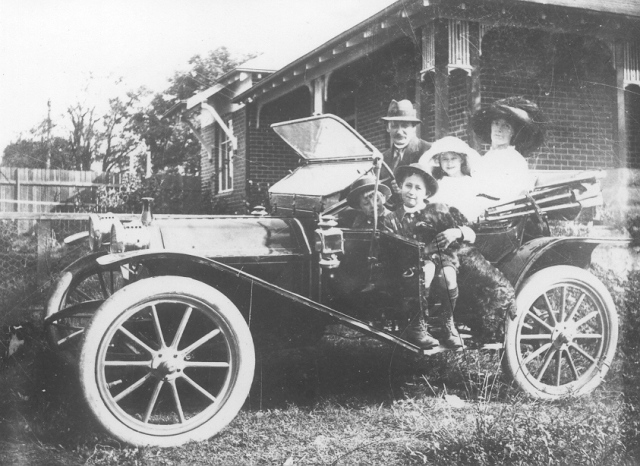
Robert Gregory
IndexPage Feedback PhotoAlbum NewsArticles
Robert Gregory
In brief
Robert spent his early life in Bolton, Manchester, trained as an engineer at Musgraves Foundry in Bolton UK before migrating to Australia. Robert arrived in Australia 1884 aged 21years aboard SS Cusco. He worked in Victoria initially then moved to mine sites in NSW during the early days of mineral extraction.
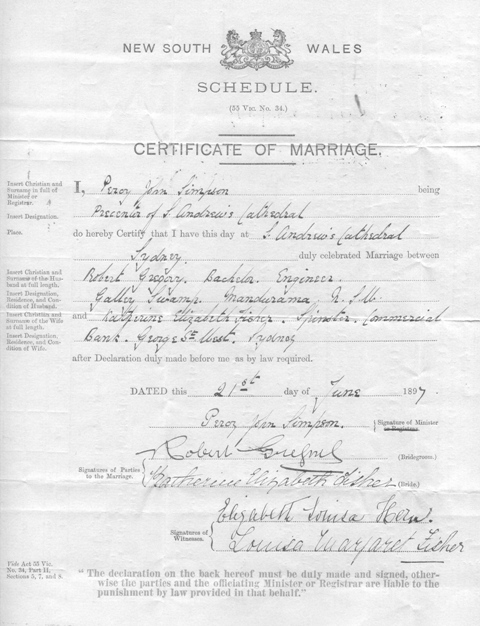
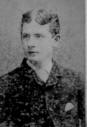
Robert Gregory III was born on 3rd June 1863 at 141 Darby Street Bolton England, the third son to Robert Gregory II and Jane Gerrard. Robert married Katherine Elizabeth Fisher on 21st June 1897 and died in Cobar, New South Wales Australia on 27th August 1936.
Siblings
Richard was born in 1859, Tom 1861,Emma 2nd April,1865 and George 1867. With the exception of Robert who migrated to Australia and Emma who on marriage went to Russia the rest of the family remained in Bolton. All the sons including Robert were engineers and all were trained at Musgrave’s Bolton Foundry.
Emma married Alex Boardman on 14th September 1885 a year after Robert left for Australia. Alex was working at Musgrave’s at the same time as Robert and his brothers. Alex had followed in his father’s footsteps and become the Manager at the Yakroma cotton mill before Emma and he became married. Other brothers were George and Tom.
Robert and his brothers were instructed in their fathers trade under his watchful direction and guidance at Musgrave’s.
Robert designed a governor for a Cotton Mill in India while he was at Musgrave's. the invention resulted in an award of £100 part of which was used to pay for the voyage to Australia. this photo was taken in the mill pre-1914
They were a very united family and the boys took a keen interest in football; indeed the youngest George played ‘outside right’ for the Bolton Wanderers for many seasons, until he left Bolton to work at Blackburn. A broken nose was Robert’s life long evidence of his football days, and this gave him something of a Jewish appearance.
In 1884, at the age of 21 years, Robert had not only completed his apprenticeship as Engineer and Draughtsman at John Musgrave & Sons Limited ‘Globe Iron Works’ of Bolton in Lancashire. But he had also received the princely sum of £100 from them, for inventing the ‘Governor’, a device for regulating the speed of machinery. Part of which Robert used twenty one pounds to pay his fare to Australia on the ‘Cuzco’. The Board of directors was dismayed that their bright young inventor should choose to go to the colonies.
After saying good-bye to his parents and sister Emma plus all the Boardman family at whose large home in Yakroma he had stayed for several months. Robert returned to Bolton via London the centre of the British Empire. There to see for the last time it’s magnificent buildings, bustling streets, horse drawn omnibuses and hansom cabs. Streets crowded with frock coated and top hatted gentlemen.
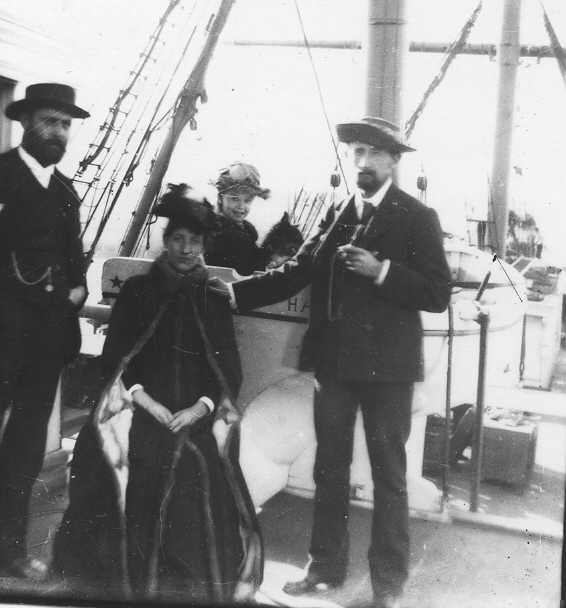
The ship sailed from Port of London (Gravesend) on 9th July 1884 in Orient Steamship Company’s ‘Cuzco’ of 3849 tons register for Melbourne. Robert travelled as a steerage passenger that meant he had to supply his own bedding and eating utensils. Food was provided according to a scale printed on the ticket.
While the ship was at Suez, Robert dived into the water to cool off against ship’s orders. He swam from Egypt to Arabia, a story that his sons heard thinking their father to be a marathon swimmer when in fact it was on a fifty metre swim.
On the Cuzco, Robert had made friends with three other boys about the same age. The four of them would go off and visit the sites when the ship docked. The three other boys were Waddington an architect who later was responsible for rebuilding Blackpool. Hector Mackay a Scot architect who went to New Zealand and later designed the Grand Pacific Hotel in Suva. And Hoover who later became the president of the United States.
Early work in Australia
After disembarking at Melbourne he presented his credentials and secured a position with Hughes, Pye & Rigby of South Melbourne as draughtsman in charge of their drawing office. Several years later this partnership was formed into The Austral Otis Elevator Company Limited. A reference given to Robert by Mr E. J. Rigby the Managing director at the time stated:
‘That he satisfactorily carried out the drawings and designing of many important works in the general mechanical engineering, mill, and mining work, and they were pleased to say they seldom had to make any alterations. He carries the best wishes of the Company for the new line he has taken up, as Consulting Mechanical engineer.’
The reference was addressed to Brisbane where he would represent the Otis Company.
Robert supervised the construction of plant for the Queensland Meat Export Co. Limited at Alligator Creek.
At the beginning of 1890 Robert moved to Sydney where he practiced as a consulting engineer and undertook the business management of Otis Sydney Branch.
In 1894 Robert travelled to Kalgoorlie where the rich gold fields were opening up. He obtained a Miners Right No 1163 dated 20th February 1894.
On returning to New South Wales a letter dated 14th December 1898 from Gally Swamp, Mr Eissler of Gallymont Goldfields Limited certified:
‘that Mr Robert Gregory had been employed as Chief Mechanical Engineer and Contractor to the Company for the period of two years, and he erected and executed the work in a masterly manner. The work involved included a 40 stamp battery with all modern appliances, including pumping arrangement, endless wire rope tramway with mechanical haulage, two large dams and all work in connection with the mine.’
In 1896 Robert met Katherine Elizabeth Fisher at a Boarding House conducted by Mrs Hern at 193 Macquarie Street North Sydney and married on 21st June 1897 at St Andrews Cathedral Sydney. The ceremony was conducted by the Precentor of the Cathedral and the two witnesses were Katie’s mother and her sister Dolly. Katie's address at the time of her marriage was Commercial Bank George Street west and Robert’s was Gally Swamp.
The bride’s step father was John Hern (brother of famous artist Charles). The family lived in the two floors above the banking chamber.
The newly weds made there way to Gally Swamp where Robert was employed as Constructional Engineer with Gallymont Goldfields Limited. The company provided a comfortable brick cottage for the couple and Katie furnished it in very good taste in keeping with the standard to which she had become accustomed. All the furniture, including a piano, had been purchased in Sydney and had been freighted by rail to Mandurama, thence by bullock wagon out to the mine a distance of some 16 kilometres.
As time went on the prospects of the mine became less promising and Robert transferred to another very rich field at Canbelego, near Cobar, known as the Mount Boppy Mine, a mine which justified itself over the next decade or so with vast quantities of gold.
Katie returned to her mother’s Boarding House at 193 Macquarie Street North Sydney. Harold’s was born at a hospital at 132 Flinders Street Moore Park on 19th May 1900. After which she moved to the residential Empire Hotel at the corner of Johnson Street and Parramatta Road Annandale. Early in 1902 Katie moved down the street to ‘Walhalla’ near Booth Street where the twins were born on 8th October 1902.
In 1908 Robert’s first form of propulsion was a motor bike registered number NSW-68 known to the family as ‘Maria’ which he used to keep appointments all around Sydney. It was only then that mechanical contraptions were coming into vogue. Prior to that he used the public transport system which was either the train or coach and horses.
In the summer of 1908 the family took off for Hobart sailing in the S.S.’Palloona’ where the family spent several months at Miss Gill’s boarding house in Davy Street. While Robert attended to business at Mount Bishoff tin Mine the family enjoyed horse drawn carriage drives to Brown’s River, Huonville and up to the ‘Cascades’ on Mount Wellington. Robert had not stayed more than a couple of weeks before he returned to Sydney on S.S.Westralia he was anxious to get back and arrange his business so he could spend more time with the family in future, that wasn’t to be.
Around 1910 Robert maintained a Consulting Office in conjunction with Mr S.E.Marks at the equitable Building 350 George Street, and set up an engineering works ‘Gregory & Brain’ on Parramatta Road Camperdown, but it was not a success although some big work was carried out on building cranes and other machines. Mr. Brain was an ex taxation officer and was left in charge when Robert went to the country. Unfortunately things always seemed to go wrong when he went away.
The loss to Robert by the closing of Gregory & Brain plus a further loss by flood of a dredge he was building ruined him financially.
In 1914 the family established themselves in a two-story home on the corner of Walton Crescent and Marmion Road Abbotsford built for Robert and Katie on three blocks of land not far from the Parramatta River. Later a lot of rock was excavated to make room for a tennis court, fernery, garage and workshop (Harold’s favourite hide-out)
From 1916 to his death in 1936, it was not a matter of being the Professional Consulting Engineer. He took work wherever it was available. For a period Robert was Manager of Tulloch’s Phoenix Iron Works Ltd. at Rhodes. He would start work at 7.30am and his twin boys would take it in turns to drive him from Abbotsford in Gerald’s Amilcar.
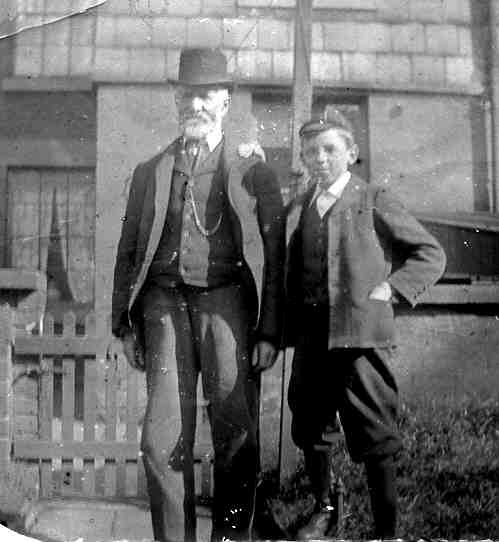
Robert seldom had a pipe out of his mouth, although he never touched strong drink, even though he came across many who did (Mr Chidgey a neighbour at Abbotsford shown in the photo was an alcoholic) as he roamed around the countryside from site to site installing plant or buying and selling machinery, advising managing and even doing a little navvy work. Robert was always on the move, if he was not at Adelong he was at Hill End or Wyangla, Araluen, Cobar, Hermidale, Canbelego, Ardlethan, Mount Boppy, Gallymont, Lobbs Hole, Blayney or Lucknow plus dozens of others.
In 1924 to 1926 Robert managed Otway Coal Company at Yan-Yan-Girt at the request of an old friend Mr Charles Binnie a Director of Bank Of NSW who was a large shareholder in this big open-cut enterprise where Robert erected an overhead travelling tramway. (Robert’s son remembered that he used to meet up with his father and have coffee with him on his way to Launceston at the time of the Tasmanian Parlor Coaches). At Yan-Yan Girt in Victoria, the lure was gold, silver, copper, tin, zinc, wolfram, iron ore, coal, every mineral imaginable.
After 1926 when Otway Coal was sold to another group, Mr Binnie financed Robert to go back to Gallymont and reopen the old workings, but without success because of the old second hand machinery breaking down.
Robert had very good connections, but his friends and clients always seemed to want him for mining work. Although a job he did in Sydney about 1930 was to design and erect the first mechanical ‘tin hare’ machinery for dog racing.
Robert returned to Canbelego many years later to extract the residue from the old Mount Boppy dumps by some modern means of treatment. The scheme was financed by the Hon. T G Murray MLC and his brother and continued for some time until Robert’s death intervened.
Robert died on 27th August 1936 while on this last assignment at Mount Boppy Cobar. Gerald drove out to Cobar to arrange for the removal of Robert’s body to Sydney, but due to the local Cobar undertaker’s inefficiency the coffin was lost in transit and did not turn up for some days with the result that an empty coffin was used for the funeral. Cremation of Robert’s remains took place some days later. Robert’s ashes were sprinkled on either side of the front gate of ‘Woodlands’ 79 Tryon Road Lindfield, the home of his son Robert Gerrard Gregory.
Source. Robert G Gregory’s Biographical Record 1970/
 Cuzco -1871
Passenger liner of 3,898 grt, owned by Orient Steam Navigation Company, built in
1871 by J Elder & Co, Glasgow. Cuzco was an iron single-screw steamer 117.09m
long, 12.62m broad and10.76m deep. She was built with 550 nhp compound engines
giving her a speed of 13 knots. Built for Pacific Steam Navigation Company's South
American service, Cuzco was chartered by Anderson, Anderson & Co and Frederick
Green & Co's Australia service on 12 August 1877, and was bought by Orient Steam
in March of the following year. A sister to Chimorazo and near-sister to Lusitania
and Garonne she carried 70 first and 92 second class passengers.
The four ex-PSN Co ships pioneered the orient service in 1877 and were by far the
finest vessels employed on either the Cape or Australian routes, lowering the
passage time by some ten days and with accommodation greatly in advance of
anything before on this service. They were purchased by their charterers in the
name of orient Steam Navigation Company in 1878, andi n this year Cuzco made a
record UK/Australia sailing in 40 days 8 hours. In 1887/8 she was re-engined by
her builders with triple-expansion engines of 4,000 ihp, and her second-class
capacity was reduced to 76 passengers. She also made a number of cruising
voyages. Cuzco made her last sailing to Sydney on 23 May 1902. She was sold to
Luigi Pittaluga of Genoa on 20 January 1905,and scrapped in March of that year.
Source P&O Group Information Beaufort House London
o)